русский
  عربى
عربى  中文简体
中文简体


Types of Medical Needles and Their Uses: A Guide for Clinicians and Buyers
Content
- 1 Needle Anatomy: The Specifications Behind Every Choice
- 2 Hypodermic Injection Needles and Their Uses
- 3 Safety Needles: Preventing Sharps Injuries by Design
- 4 Intravenous and Butterfly Needles for Vascular Access
- 5 Specialty Needles for Specific Clinical Tasks
- 6 Matching the Needle to the Syringe and the Task
- 7 How to Choose Needles With Confidence
Walk into any clinic, laboratory, or vaccination point and you will find rows of needles that look almost identical at arm's length. Look closer, and the differences in bevel geometry, gauge, length, and hub design decide whether an injection is comfortable, whether a blood sample is usable, and whether a procedure goes to plan. Understanding the types of medical needles and their uses is therefore not an academic exercise. It is the foundation of safe clinical work and confident purchasing.
Below is a practical breakdown of needle anatomy, the gauge system, the main needle families, and the questions that help clinicians and buyers match the right needle to the right job.
Needle Anatomy: The Specifications Behind Every Choice
Every needle, from a fine insulin tip to a large-bore trauma needle, is built from the same three elements: the hub that locks onto a syringe or infusion line, the cannula that forms the shaft, and the bevel, the angled tip that opens tissue. Around that simple frame, manufacturers vary a handful of measurable specifications.
Gauge: The Inverse Scale
Gauge describes the outer diameter of the cannula, and the scale runs backwards: a 14 G needle is thick, while a 31 G needle is thinner than a human hair. A higher gauge number means a smaller bore, less tissue trauma, and slower flow. That trade-off between patient comfort and fluid transfer rate drives most needle selection.
Length, Wall Thickness, and Material
Length is matched to tissue depth. A short needle of roughly 16 mm reaches subcutaneous fat, while a 40 mm needle is needed to reach deep muscle. Wall thickness, whether regular, thin, or extra thin, changes flow rate without altering the outer diameter, which is why two needles of the same gauge can behave quite differently. Most disposable needles use 304 stainless steel for its stiffness and tensile strength, while 316 stainless steel appears where corrosion resistance matters more.
| Gauge | Approximate outer diameter | Common applications |
|---|---|---|
| 14 G to 16 G | 2.1 mm to 1.6 mm | Trauma care, rapid fluid replacement, blood donation |
| 18 G | 1.2 mm | Infusion, transfusion, medication administration |
| 20 G to 21 G | 0.9 mm to 0.8 mm | Routine intravenous therapy, intramuscular injection |
| 22 G to 23 G | 0.7 mm to 0.6 mm | Vaccination, intramuscular and subcutaneous injection |
| 25 G to 27 G | 0.5 mm to 0.4 mm | Intradermal testing, paediatric and delicate injections |
| 29 G to 31 G | 0.33 mm to 0.26 mm | Insulin delivery, fine dental and aesthetic procedures |
Hypodermic Injection Needles and Their Uses
Hypodermic needles are the family most people picture when they hear the word needle. They deliver medication or withdraw fluid through the skin, and the route of delivery determines far more than the length of the shaft.
Intramuscular Injections
IM injections bypass skin and fat to reach muscle, which has a rich blood supply and absorbs medication quickly. Typical choices are 21 G to 25 G needles measuring 25 mm to 40 mm, with 22 G and 23 G offering a common compromise between flow and comfort. Vaccines, antibiotics, and many hormonal preparations are given this way.
Subcutaneous Injections
SC injections target the fatty layer just beneath the skin, where absorption is slower and more even. Insulin, heparin, and many biological drugs belong here, usually delivered through 25 G to 27 G needles of 8 mm to 16 mm. Shorter, finer needles have largely replaced the longer needles once used for insulin.
Intradermal Injections
ID injections deposit a small volume into the dermis itself, creating the raised wheal used in allergy and tuberculin testing. These demand very fine, short needles, typically 26 G to 27 G and around 10 mm, held almost parallel to the skin.
Intravenous Injections and Infusion
IV work uses larger gauges because fluid must move quickly: 18 G to 22 G for routine infusions, 14 G to 16 G for trauma and rapid replacement. Peripheral IV cannulas are measured on the same gauge scale, which keeps the language consistent across needles and catheters.
Whatever the route, the specification should follow the clinical requirement rather than the habit of the department.
 Sterile Hypodermic Needle for Single UseProduct Overview The Sterile Hypodermic Needle for Single Use is a standard clinical consumable used for routine subcutaneous and intramuscular injections, drug admini...View Product →
Safety Needles: Preventing Sharps Injuries by Design
Sharps injuries remain one of the most common occupational risks in healthcare, and a single needlestick can transmit bloodborne pathogens. Safety-engineered needles respond with a mechanism that covers or retracts the tip immediately after use: a sliding shield, a hinged cap, or a spring-loaded retraction that locks the needle inside the barrel. Blunt-tip filling needles add another layer of protection by removing the sharp point from medication preparation altogether. Passive designs, which engage without any extra action from the user, are generally considered more reliable than active ones, because they take the human step out of the equation.
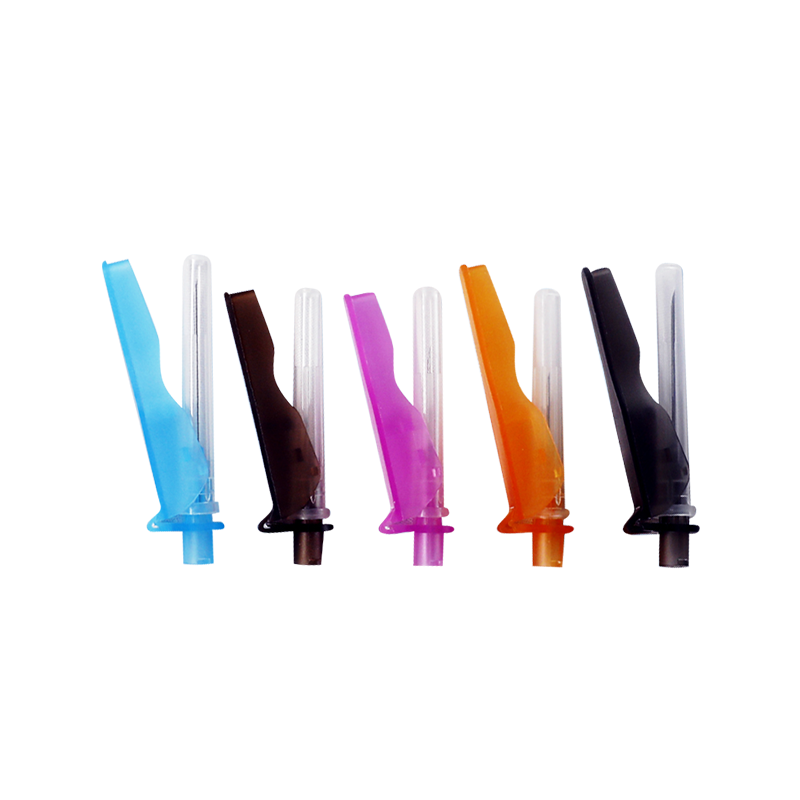 Safety Needle for Single UseProduct Overview The Safety Needle for Single Use is an advanced injection and blood collection needle featuring an integrated safety mechanism that activates after us...View Product →
Intravenous and Butterfly Needles for Vascular Access
Butterfly needles, also called winged infusion sets, combine a thin needle with two flexible plastic wings and a length of tubing. The wings give the clinician a stable grip and a low angle of entry, which makes them a favourite for short-term intravenous access, blood sampling, and patients with fragile or rolling veins. Gauges usually run from 21 G to 25 G, with 23 G the most widely used compromise. Because the needle sits directly in the vein rather than inside a plastic cannula, butterfly needles suit short procedures and should be removed once the sample or infusion is complete.
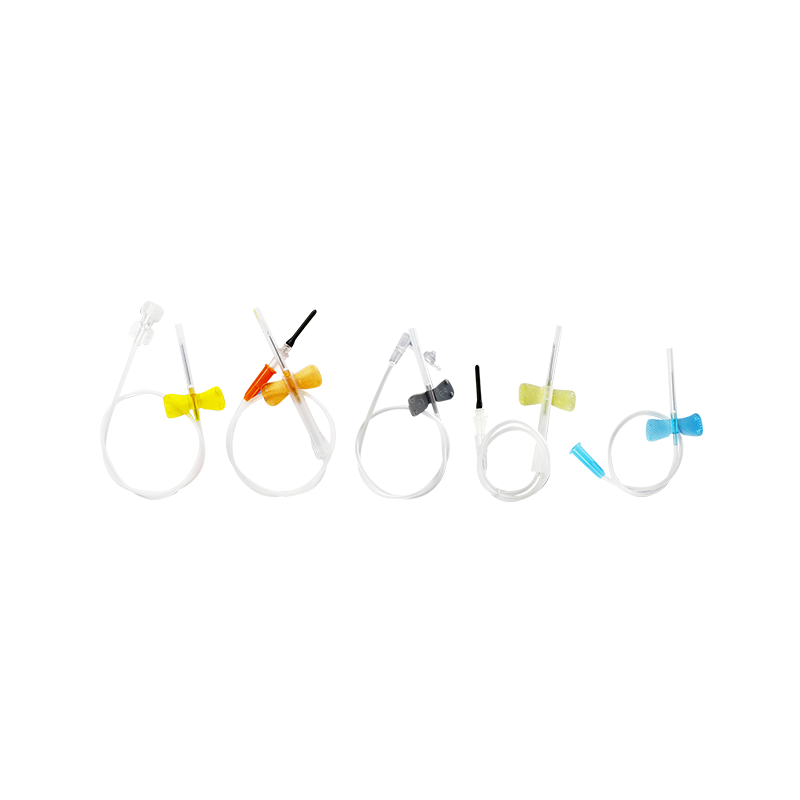 Sterile Intravenous Needle for Single Use (Butterfly Needle)Product Overview The Sterile Intravenous Needle for Single Use, commonly known as the Butterfly Needle, is a short-bevel needle with flexible wings and attached tubing...View Product →
Specialty Needles for Specific Clinical Tasks
Outside routine injection and infusion, needles are shaped around a single purpose.
Insulin and Pen Needles
Insulin syringes and pens use fixed ultra-fine needles, typically 29 G to 31 G and 8 mm or shorter, matched to the shallow subcutaneous layer.
Dental Needles and Irrigation Tips
Dental anesthesia calls for short, fine needles that reach buccal or palatal tissue, while irrigation tips deliver saline into root canals and surgical sites through a blunt or side-venting opening.
Filter, Venting, and Blunt-Tip Needles
Filter needles draw medication through a membrane that traps glass particles after an ampoule is opened, and venting needles equalise pressure when a vial must be accessed repeatedly.
Spinal, Epidural, and Biopsy Needles
These procedural needles use specialised tips, such as pencil-point or cutting bevels for spinal anesthesia and cutting or trapping geometries for tissue sampling, so the needle separates or captures tissue in a controlled way.
Matching the Needle to the Syringe and the Task
Needle and syringe must fit together without leaking or disconnecting under pressure. Luer slip hubs push onto a tapered syringe tip and suit low-pressure tasks, while Luer lock hubs screw into place and are preferred wherever a line might be pulled or pressurised. Hub dead space matters too: a needle with a wide internal volume retains more medication, which is a real concern with expensive biological drugs and small paediatric doses. For teams standardising across departments, it helps to view needles as part of a wider range rather than as isolated items. Our medical solution overview groups the consumables typically used together in injection, infusion, and vascular access workflows.
How to Choose Needles With Confidence
A short checklist keeps selection consistent across a ward, a clinic, or a distribution catalogue:
- Confirm the route: intramuscular, subcutaneous, intradermal, intravenous, or procedural.
- Match gauge to the fluid and tissue, using a larger bore for viscous fluids and rapid flow, and a finer bore for comfort and precision.
- Match length to the patient's body composition rather than to a default size.
- Check the safety feature: passive activation, single-use construction, and compatibility with the sharps containers already in use.
- Verify documentation, including sterile single-use packaging, lot traceability, and the regulatory references that apply to that specific product.
Regulatory status deserves particular attention. Certifications and listings usually cover defined product families rather than an entire catalogue, so the applicable scope should always be confirmed before purchase. Our guide to choosing a reliable medical consumables supplier walks through the audit and documentation points worth checking before a first order.
Needles are small, inexpensive items that carry a disproportionate share of clinical risk and patient experience. Getting the specification right, from gauge and length to bevel geometry, safety mechanism, and hub fit, is a shared responsibility between the people who use them and the people who source them. As a manufacturer of single-use medical consumables based in Taixing, Jiangsu, we see both sides of that equation every day: how a fraction of a millimetre in bevel geometry shows up in a patient's comfort, and how consistent quality documentation keeps a supply programme running smoothly. Our applicable product lines are supported by an ISO 13485 quality management system, EU MDR quality management system certification for listed families, FDA establishment registration and device listing for the U.S. market, and 510(k) clearance for specified sterile syringe and hypodermic needle products, with manufacturing, packaging, and OEM/ODM support available for selected ranges.
Related Product
Related NEWS