русский
  عربى
عربى  中文简体
中文简体


0.06 ml on an Insulin Syringe: How Many Units Is That and How to Measure It
Content
- 1 The Short Answer: 0.06 ml Is 6 Units on a U-100 Syringe
- 2 Concentration Comes Before Conversion
- 3 Reading 0.06 ml on the Three Common Barrel Sizes
- 4 Why Tiny Volumes Magnify Tiny Errors
- 5 Needle Gauge and Length for a Six-Unit Dose
- 6 What If the Volume Does Not Land on a Mark?
- 7 How We Approach Syringes Built for Small Doses
- 8 Frequently Asked Questions
An insulin syringe is not marked in millilitres. It is marked in units, and the two scales rarely line up in a tidy way. So when a prescription, a dosing chart or a veterinary instruction note says 0.06 ml, the first useful step is to translate that volume into the numbers printed on the barrel. On a standard U-100 insulin syringe, 0.06 ml is 6 units. That single conversion answers the headline question, but the details around it, concentration, barrel size, graduation marks and needle choice, are what decide whether those 6 units are drawn accurately.
The Short Answer: 0.06 ml Is 6 Units on a U-100 Syringe
U-100 insulin contains 100 units in every millilitre, and a U-100 syringe is scaled to match. That gives a simple relationship worth remembering: 1 unit equals 0.01 ml, and 1 ml equals 100 units. Divide 0.06 by 0.01 and you arrive at 6 units. The same arithmetic handles any small volume you meet, and the table below gathers the figures people ask about most.
| Volume | Units on a U-100 syringe | Units on a U-40 syringe |
|---|---|---|
| 0.02 ml | 2 units | 0.8 unit |
| 0.05 ml | 5 units | 2 units |
| 0.06 ml | 6 units | 2.4 units |
| 0.10 ml | 10 units | 4 units |
| 0.30 ml | 30 units | 12 units |
| 1.00 ml | 100 units | 40 units |
Notice how quickly the numbers grow. A tenth of a millilitre is 10 units, and a quarter of a millilitre is 25 units, which is why a 0.06 ml dose sits right at the low end of what an insulin syringe is expected to deliver faithfully.
Concentration Comes Before Conversion
The 6-unit answer only holds when the insulin in the vial is U-100. The same 0.06 ml drawn from a U-40 vial contains just 2.4 units, and drawn from U-500 it would contain 30 units. Because the barrel cannot tell you what is inside the vial, the concentration printed on the label is the first thing to check and the last thing to forget. U-40 insulin is still widely used in veterinary practice in a number of countries, which is one reason pet owners occasionally run into confusing conversions when a chart written for human insulin is applied to an animal.
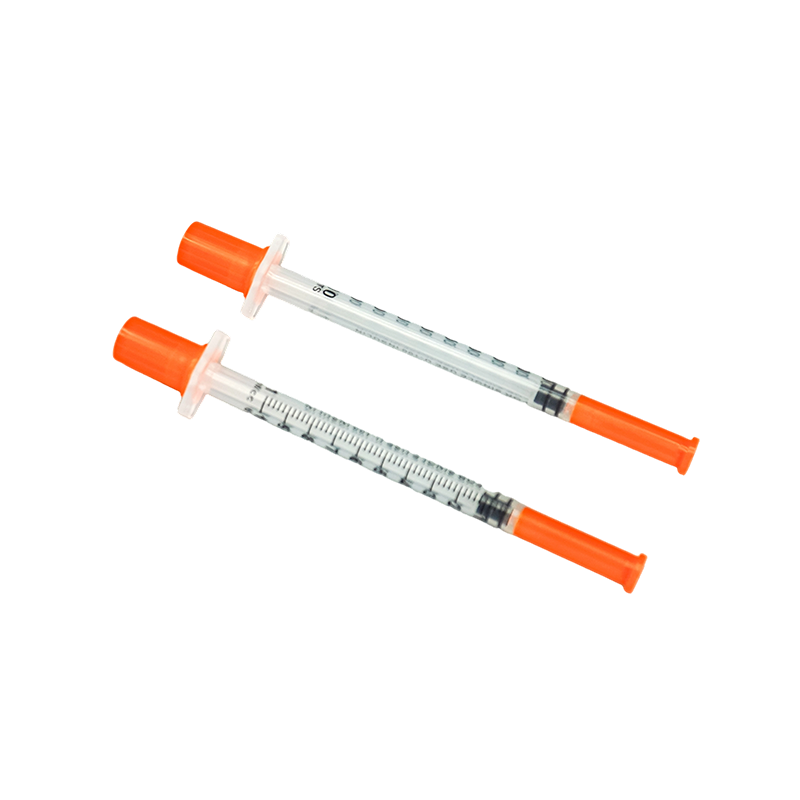 Veterinary Insulin Syringe for Small-Volume Pet DosesPrecision small-volume syringe with fine-gauge needles and IU graduations for consistent insulin dosing in diabetic dogs and cats.View Product →
If you are dosing a pet, it is worth using a syringe marked for the concentration you actually have on the bench, rather than a human U-100 barrel with a mental conversion attached to it.
Reading 0.06 ml on the Three Common Barrel Sizes
Insulin syringes are commonly sold in 0.3 ml, 0.5 ml and 1 ml barrels, and the graduations are not identical across them.
0.3 ml, 30-Unit Barrel
The smallest of the three usually carries a mark for every single unit. Six units is simply the sixth line up from zero, which makes 0.06 ml one of the easiest doses to read on this size, and it is a common reason people who take small doses prefer it.
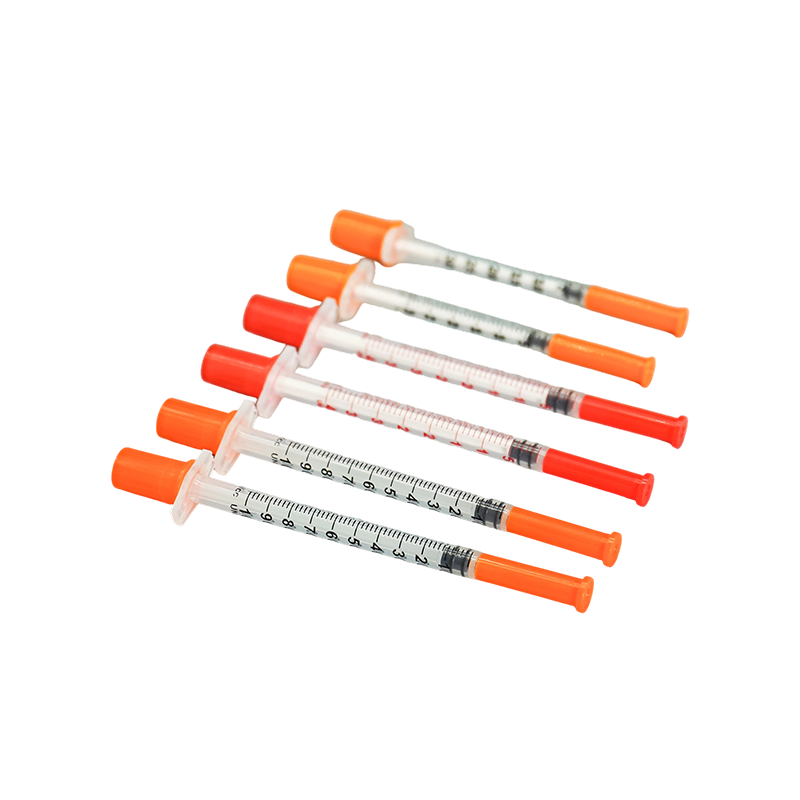 Disposable Insulin Syringe with 40 IU and 100 IU ScalesFixed-needle syringe in 0.3-1 ml sizes with fine graduations, useful for reading small-unit insulin doses accurately.View Product →
0.5 ml, 50-Unit Barrel
A 0.5 ml barrel generally has 1-unit markings as well, so 6 units again lands on the sixth line. The extra capacity simply means the rest of the barrel goes unused for a dose this small.
1 ml, 100-Unit Barrel
The largest of the three sometimes prints a mark every 2 units instead. In that case, 6 units is the third mark above zero. It remains readable, but the resolution is coarser, and a half-unit error matters more when the whole dose is only 6 units. Printing 1-unit graduations on a 1 ml barrel, as we do, keeps small doses legible.
Half-unit syringes exist as well. On those, 0.06 ml is the twelfth half-unit mark, which helps when a prescriber has deliberately asked for finer control.
Why Tiny Volumes Magnify Tiny Errors
At 6 units, a one-unit slip is roughly a seventeen percent change in dose, so the practical details deserve real attention.
- Prime the needle first, because air trapped in the hub can push the liquid volume out of step with the scale.
- Draw slowly and keep the bevel under the surface of the insulin to avoid pulling air.
- Read the top of the plunger seal at eye level rather than at an angle.
- Use the syringe once. A reused barrel loses lubrication, the plunger can stick, and the delivered dose drifts.
- Never substitute a 3 ml or 5 ml syringe for a 0.06 ml dose, since those graduations are far too coarse.
We have written about the wider version of this point in our note on disposable versus reusable medical consumables, and the short version is that single-use design serves accuracy as much as hygiene.
Needle Gauge and Length for a Six-Unit Dose
Needle gauge describes thickness, and higher numbers are finer. Insulin syringes usually sit between 28G and 31G. For a small subcutaneous dose, a 30G or 31G needle in a short length is often the most comfortable option, while a slightly thicker needle may suit someone who prefers a firmer feel as the plunger moves. Dead space inside the needle hub also deserves a thought: a fixed-needle insulin syringe leaves less residual volume than a detachable needle screwed onto a separate barrel, and that difference becomes proportionally larger when the dose itself is only 0.06 ml.
 Sterile Single-Use Hypodermic Needle for Standard Luer SyringesSingle-use needle with stainless steel cannula and PP hub, compatible with standard Luer syringes for routine injections and blood sampling.View Product →
For anyone assembling a combination of their own, a needle produced to match standard syringe fittings keeps the hub seal tight and the residual volume predictable.
What If the Volume Does Not Land on a Mark?
Sometimes the arithmetic produces a figure that falls between graduations. With U-100 insulin, 0.06 ml is a whole 6 units, so it lines up cleanly on a 1-unit barrel. The difficulty appears with U-40 insulin, where the same volume works out at 2.4 units, or with prescriptions written at fractions of a unit. Rounding is a clinical decision rather than a matter of convenience, because a difference of one unit can be meaningful when the total dose is small. Any adjustment belongs with the prescriber, a diabetes educator or the veterinarian who wrote the instructions.
How We Approach Syringes Built for Small Doses
Our company has been making disposable medical consumables since 2005 from our base in Taixing, Jiangsu, and insulin syringes are one of the lines we have focused on, alongside disposable syringes, auto-disable syringes, hypodermic needles, butterfly needles and infusion sets. Regulatory references apply only to the products they cover: our quality management system holds ISO 13485 certification for applicable medical device activities, EU MDR quality management system certification covers insulin syringes and other listed lines, and our U.S. market documentation includes FDA establishment registration and device listing, with FDA 510(k) clearance for specified sterile syringe and hypodermic needle products. For partners, we also offer manufacturing, packaging and OEM/ODM support on selected non-medical and beauty-related consumables. Our medical solution pages set out how these lines fit together in practice.
Frequently Asked Questions
Is 0.06 ml the same as 6 units?
On a U-100 insulin syringe, yes. The conversion depends on concentration, so 0.06 ml equals 6 units only when the insulin in the vial is U-100.
Which syringe size is easiest for 0.06 ml?
A 0.3 ml, 30-unit barrel with 1-unit graduations gives the clearest read at this volume, though a 0.5 ml barrel works just as well when it carries the same markings.
Can six units be measured on a 1 ml syringe?
Yes, as long as you know how that barrel is graduated. If each mark equals 2 units, 6 units is the third mark from zero.
Does a smaller syringe change the dose?
No. It changes how precisely you can read and draw the dose you were given. The volume itself stays the same.
Six units is a small number, and small numbers reward careful habits: check the concentration, choose a barrel you can read, prime the needle, and trust the graduations rather than a guess. Handled that way, 0.06 ml stops being an awkward figure on a chart and becomes a dose you can measure with confidence.
Related Product

Related NEWS